BLOOMINGTON, Ill. – Illinois Wesleyan University students are turning up the heat this semester in the Petrick Idea Center’s test kitchen.
Carolyn Nadeau’s “Food, Culture and Society” class is a new offering this year, allowing students to do more than simply sit in a classroom.
The Health Sciences department was in the development process of the nutrition major last year, and realized there was typically a non-science-focused food culture class and asked Nadeau if she was interested in teaching it.
“A lot of my research is in the Humanities — food representation and literary and cultural forms, so I just love the topic and I’ve published quite a bit on it,” explained Nadeau, who is the Chair of the World Languages, Literatures and Cultures Department and the Byron S. Tucci Professor of Spanish.
She said she partially designed the course as writing intensive, so students could reflect on the process, and built it into five separate units.
Those five units include foundations ‒ thinking about what food, culture and society are to the foundations of the food lab. The second unit, ongoing now, is Food Systems and Change, focusing on food practices throughout history and comparing to modern day; then Social and Sacred Foods, centered on the role of religion in food practices; Food Activism and Social Justice, the role of politics and economics in food; and finally, The Emergence of American Food Culture.
“In the Humanities, food is so much more than just the biological, and that is principle. We’re not living without food, right? But those social contexts, those economic forces, food is powerful and it’s still powerful today,” Nadeau said.
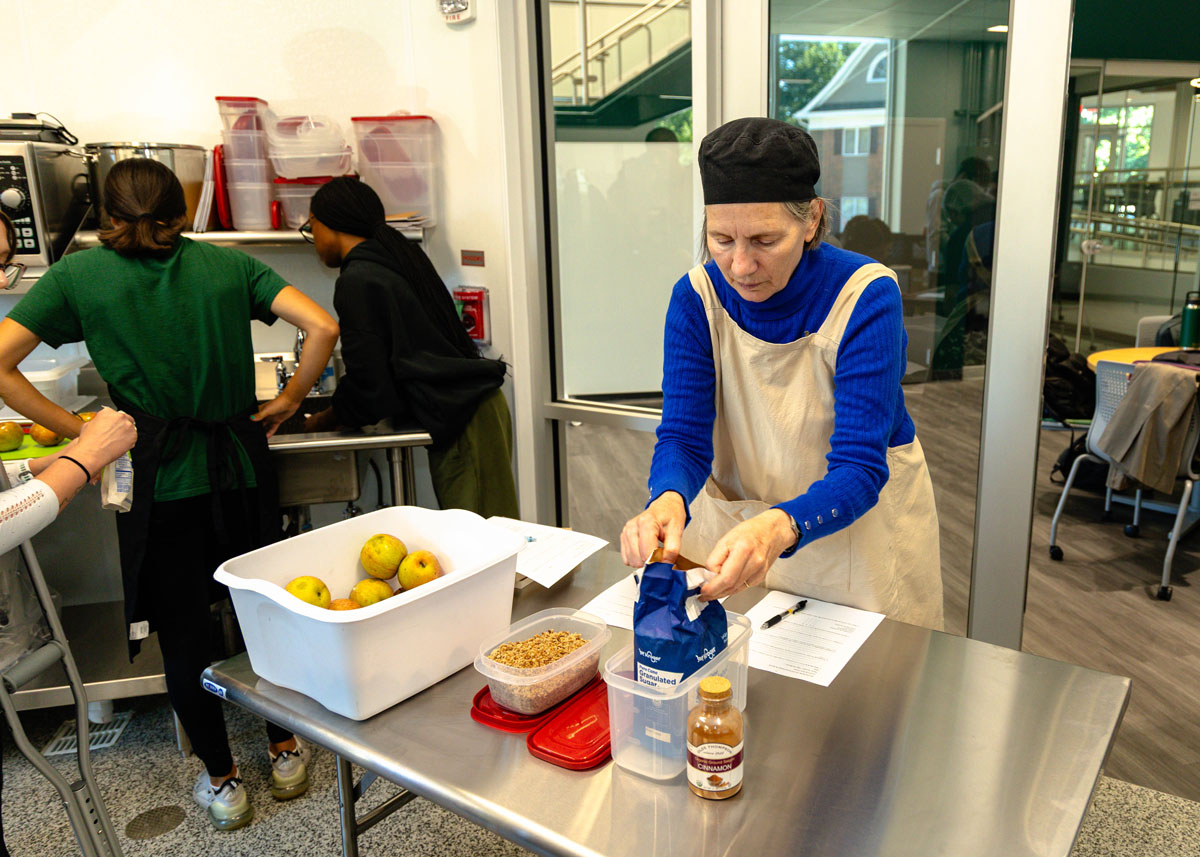
She wants people to view food as another art form — the connection and human expression of what kind of food matters and who it matters for.
As part of the current unit, students recently made a Mirrauste de manzana recipe, a historic Catalan Renaissance dish from 1520, including apples, sweet almonds, breadcrumbs, traditionally rice milk or broth, sugar and cinnamon. The dish has the same flavor profile as today’s applesauce.
Students were then tasked with selecting a recipe from the archives, and either chose a hardcopy from award-winning cookbooks in the Minor Myers Reading Room of the Ames Library, or a family recipe. Then they had to write a comparative analysis on how the recipes differentiate between time periods.
Students will also have the opportunity to learn how to carve a turkey and make five French sauces as well as beignets.
“The students are coming to terms with their own food identities and what that might represent in broader strokes,” she said.
Luke Alberstett, a senior political science major, said he has enjoyed Nadeau’s class because he loves to cook and be in the kitchen. He said working in the Petrick food lab has also been a great experience for him.
So far, the dishes he has made in class are a traditional applesauce with almond sauce and Southwest-style burritos.
“We have taken the time to learn and understand how food is connected to humanity across the world. All facets of food are a key component of the human experience, and in this class, we have really taken the time to see how food connects to cultures all the way from the 17th century to now,” Alberstett said.
Alberstett said he is glad he chose to register for the class and encourages others to try it out, too.
The course is cross-listed in both the Health curriculum and Humanities at the 200 and 300 level, respectively.
A total of 30 students are enrolled in the class this semester. The entire group meets on Mondays from 10-11:15 a.m., and then the group is split into groups of 16 and 14, respectively, to use the test kitchen on either Wednesday or Friday from 10-11:15 a.m.
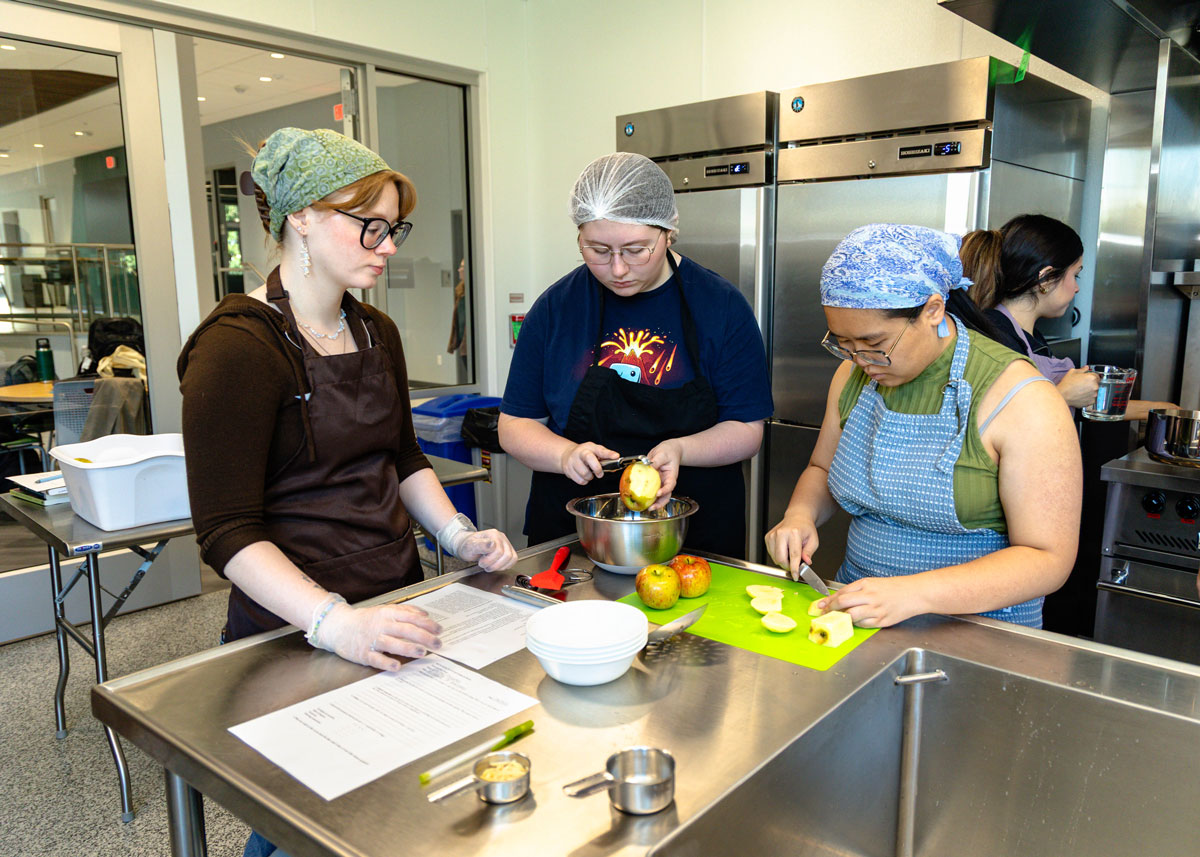
For each class held in the Food Laboratory, students read recipes, gather equipment, designate roles within their group and organize. At the end of each class session, they complete exit tickets.
Nadeau said the class was designed to be offered every other year, but hopes she will teach it next fall if there is student interest.
“For those nutrition majors, I just want them to have that fuller context. It’s not all about vitamins and minerals. That’s important, don’t get me wrong, but if you miss that big picture, you’re missing a part of people’s nutrition,” she explained.
Other elements of the course include movie screenings, volunteer opportunities with local food pantries and the farmers’ market, guest speakers and the Great IWU Bake Off, which Nadeau said is a personal highlight for her, taking place the week of Oct. 19.
Students will learn about celebratory foods and design, bake and decorate their very own cakes to be judged by a panel, including Petrick Idea Center Director Ben Hage, a local baker and more.
“It is always exciting to be part of the student experience. Having the opportunity to help them with this exercise as a judge is super. I’m looking forward to seeing their creations,” Hage said.
“Petrick is a space for students. The more students use our space in a meaningful way, the more successful we are. I get excited to see class in Petrick and activities. The building is best when it’s busy and loud.”
Guest lecturers include Gina Hunter, a scholar who will speak about edible insects with the class on Oct. 7, and Vivan Kong Doctora, a local entrepreneur who is a partner in Bloomington’s Kobe Revolving Sushi Bar and has her own bao business. Doctora will talk about bringing traditional Chinese family cuisine to Bloomington-Normal on Nov. 9.
Kong Doctora said she plans to share her entrepreneurial journey — how she got started, what inspired her to go that route and how her passion for food played a role.
She plans to have students participate in a hands-on experience where they will learn how to fold bao and taste them. She hopes they will gain a new skill, an appreciation for her culture and an understanding of how food connects people and cultures around the world.
“Most importantly, I want them to see that it’s never too late to give yourself permission to reinvent yourself, explore your passions and pursue your purpose — whether that leads to creating food, starting a business or simply following an idea that excites them,” she said.
She hopes they also leave with confidence to ask themselves, “What if?” and the courage to start anywhere.
The class will culminate with students either writing about American cuisine or creating the beginnings of an Illinois Wesleyan-themed cookbook.